
About this episode
Sophie Blackall builds hers through imagination and community. The two-time Caldecott Medal-winning author and illustrator, known for works such as Hello Lighthouse, If You Come to Earth, and Finding Winnie, has spent her life transforming that search into stories.
“When we are making books, we are making little homes for our readers that they can return to hopefully again and again and again, just as we return to books and find a sense of home, we return to the person we once were, when we were reading that book.” — Sophie Blackall
In this episode, Sophie shares her nomadic childhood, her fixation on the idea of home, and why she never feels settled. She also discusses the books she reaches for to feel safe. We also talk about Milkwood—the magical farm retreat she created for the children’s book community to cook, commune, and collaborate.
Settle in for a wide-ranging conversation that explores the meaning we construct within and around our lives.
***
***
This week's Beanstack Featured Librarian is Kimberly Thompson, the library media specialist at East Side Middle School in Bullock County, Kentucky. She tells us all about the Kentucky Bluegrass Awards and how they’re getting everyone in her school reading, including the adults!
***
Listen to the full episode, "No Wasted Sunshine: Sophie Blackall on the Meaning of Home" on Apple, Spotify, Castbox, or wherever you get your podcasts. Like what you hear? Please leave a 5-star review, subscribe, and share with someone who will enjoy it!
Whatever you do, keep reading!
Contents
-
Chapter 1: Where Is Home?
-
Chapter 2: Wasted Sunshine
-
Chapter 3: A Perfect Picture Book
-
Chapter 4: Not Just a Farmhouse
-
Chapter 5: Under Milk Wood
-
Chapter 6: Paper Houses
-
Chapter 7: So Now What?
-
Chapter 8: Reading Challenge
-
Chapter 9: Beanstack Featured Librarian
Author Reading Challenge
 .
.
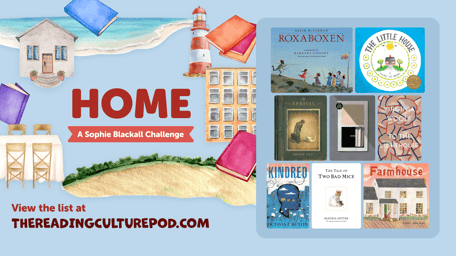
Home: A Sophie Blackall Challenge
- Roxaboxen by Alice McLerran and illustrated by Barbara Cooney
- The Little House by Virginia Lee Burton
- Arrival by Shaun Tan
- Here by Richard McGuire
- To the Lighthouse by Virginia Woolf
- Kindred by Octavia Butler
- The Tale of Two Bad Mice by Beatrix Potter
Links:
- The Reading Culture
- The Reading Culture Newsletter Signup
- Follow The Reading Culture on Instagram (for giveaways and bonus content)
- Sophie Blackall
- Sophie Blackall website
- Milkwood Farm
- How to Not Waste Your Live (The Marginalian)
- Roxaboxen
- Under Milk Wood
- A creative retreat for the children’s book community
- Beanstack resources to build your community’s reading culture
- Jordan Lloyd Bookey
Sophie Blackall: When we're making books, we're making little homes for our readers that they can return to hopefully again and again and again. Just as we return to books and find a sense of home. We return to the person we once were when we were reading that book.
Jordan Lloyd Bookey: Home. It's something we spend our whole lives building and rebuilding. Sometimes it's made of walls and windows and others it's made of words. Sophie Blackall builds hers through stories, through community, and through the act of noticing. A two time Caldecott Medal winning author and illustrator, she's known for books like Hello Lighthouse, If You Come to Earth, and Ivy and Bean.
In this episode, Sophie tells us about her nomadic childhood, why she is fixated on the idea of home and yet never feels settled, and what books she reaches for when she just needs to feel safe. We also talk about Milkwood, the magical farm retreat that Sophie created just for the children's book community to cook, commune, and collaborate. My name is Jordan Lloyd Bookie, and this is the reading culture, a show where we speak with diverse authors about ways to build a stronger culture of reading in our communities. We dive deep into their personal experiences and inspirations. This show is made possible by Beanstack, the leading solution for motivating people to read more.
Learn more at beanstack.com, and make sure to check us out on Instagram at the readingculturepod and subscribe to our newsletter for bonus content at the readingculturepod.com forward slash newsletter. Alright. On to the show. Hey, listeners. Are you looking for a fun, easy way to track your reading and earn cool rewards?
Well, meet Beanstack, the ultimate reading app used by a community of over 15,000 schools, libraries, and organizations nationwide. Are you an avid reader? Check with your local library to see if they offer Beanstack for free. A parent? Ask your child's teacher if the school library already uses Beanstack.
And if you are an educator searching for a fresh alternative to accelerated reader, Beanstack is the perfect tool to cultivate a thriving reading culture. Ready to turn the page? Visit beanstack.com to learn more. We grew up with your books, and they're just so beautiful. They really capture so much, and I just I'm excited to speak with you.
Let's start off because one of the themes we wanna talk about is home, and I wanted to just ask what home felt like for you growing up in Australia.
Sophie Blackall: I lived with my mother for most of my childhood, and she was a serial house mover.
Jordan Lloyd Bookey: Oh.
Sophie Blackall: So we lived in so many different houses. She would buy an old falling down house and painstakingly restore it. And just when it was all nice and comfortable and the windows and doors opened and shut and the rooms were painted, we would move. I don't know if it was restlessness or just a creative energy that she wanted the puzzle and the project of making a new home. But, yeah, as kids, we moved and moved and moved.
And she still moves and moves and moves. Really? And I realized only recently that the rental apartment in New York where we my husband and I raised our blended family, we had all been in it for ten years when we our kids left home for college, and and we downsized during COVID. It was the longest any of us had ever lived in one place, which was kind of interesting to be 50 and that that was the place. But having said that, the houses my mother made were beautiful, and they were filled with old things and books and materials to make things and a garden and animals.
They were not necessarily expensive things, but they were chosen with care, and they would move with us from house to house. So there was always a sense of continuity because of the things. And so those homes, though there were many of them, were all wonderful in one way or another.
Jordan Lloyd Bookey: So you really learned some of that craft of mending and that type of thing from your mom?
Sophie Blackall: Definitely. I think my mother could build a house in a forest with her teeth.
Jordan Lloyd Bookey: Wow.
Sophie Blackall: Yeah. She can make a basket out of grass and twigs and can sew and weave and all of those things. And I did learn as much as I could from her, and those are things that I still love to do.
Jordan Lloyd Bookey: Such a gift to be able to do things with your hands. So your mom just moved, but for no particular reason, and you had siblings?
Sophie Blackall: I have an older brother. Yeah. So it was the three of us. Okay. Yeah.
No particular reason other than wanting, I think, a new adventure. Maybe she was looking for something that she never found without wanting to go into making this into a therapy session, Jordan.
Jordan Lloyd Bookey: Bring it on.
Sophie Blackall: Yeah. It is interesting, that desire to move. And I wonder on some level whether I've inherited it. Here I am. I've been on the road for nearly six weeks.
We split our time between a tiny apartment in Brooklyn, New York, a rambling farmhouse in Upstate New York. I go back to Australia once a year. I do research trips. I travel for my books. I am rarely in one place for longer than a few weeks.
And I so I don't know I don't know what that is. And yet, I love home. I think about home. I write about home. I make pictures about home.
I read books that are centered in some idea of place and home and what that means, and it occupies my thoughts all the time, and yet I'm not very settled.
Jordan Lloyd Bookey: I was thinking about the Hello Lighthouse and just the idea of, like, this very confined space. You're the inverse of that story, really Yes. And living in the big ocean.
Sophie Blackall: And the book that I'm working on currently having done a book about a lighthouse, a book about a farmhouse, is a book called House on Wheels. Oh. And my husband, Ed, who is just so game and generous and willing, goes on these crazy adventures with me. And I said, I think I wanna do a book called House on Wheels about a trailer, a literal house on wheels and Like a camper. Yeah.
A camper. And what it's like to live with two plates and two cups and two bowls or three or four, and to move from place to place, but to have that juxtaposition of the ever changing exterior and the constant interior, which was something I was playing with and interested in with lighthouse as well. But this is unlike lighthouse that is constant and steadfast, and what is changing is weather and time and the passing ships and storms. With House on Wheels, we are the ones moving. And I said to Ed, I think I need to go and get a House on Wheels, and I think we need to go on a
Jordan Lloyd Bookey: go on And a trip in he was like,
Sophie Blackall: can't you Google?
Jordan Lloyd Bookey: Can you do some interviews?
Sophie Blackall: No. So he also came with me to stay in a lighthouse and helped me
Jordan Lloyd Bookey: I saw you were at sea on Instagram. I saw
Sophie Blackall: you We were at sea exactly, because that's another book I'm working on called The Sea, A Love Story, which is also about home in its way. And yeah. So he's game. But I'm also in LA for his play, it goes both ways.
Jordan Lloyd Bookey: Sophie is someone who's always noticing, always finding beauty in the quiet corners of her surroundings, cataloging moments and small details and turning them into something lasting. There's intention in the way that she looks at the world as if this attention to the details itself is a kind of care, a way of making the most of the time that we have here.
Sophie Blackall: I was reading do you ever read The Marginalian, Maria Poppos? Yeah. She's so incredibly smart, but she pulls together all of these other smart thinking people. And she was writing recently about Nathaniel Hawthorne, who was consumed with this idea of how to live a life that he said I wrote this down. He said, how to live in order not to look back with a lament for life's wasted sunshine.
Oh. Oh. Oh. That's beautiful. Wow.
Jordan Lloyd Bookey: How are you doing that? What I'm thinking about now is, like, I think a lot of people consider, like, thinking of collecting and keeping things, things that maybe other people would consider trash or just consider something they have to let go of. You know? And I just wonder how, like you know, when you bring in these, like, stories of other people, what that does for you and your sense of place in in, like, the continuum, I guess. I think it's part of a deep desire to connect with other people and try to understand other people, all the while knowing that we can no more understand the person in front of
Sophie Blackall: us than we can understand ourselves. We can just try our best. However, we do that by watching and listening and looking closely and being attentive. I was thinking about do you know Myra Kaumann, the writer and illustrator? No.
She is wonderful. She's done a lot of children's books, but also illustrates grown up illustrated books and for The New Yorker and The New York Times. And she has a book called The Principles of Uncertainty. And there's a drawing in there. It's one of my favorite pages, and I talk about it a lot.
It's a drawing of a woman she sees somewhere with magnificent hair and three bobby pins on the side of her head. She says, but there might have been six because I couldn't see the other side. That idea that we only see one side, we see this one thing in front of us. We don't know what's happening on the other side. We don't know what's happening inside someone's head.
And all we can do is try not to leap to conclusions and try not to judge and to keep our minds open and to be patient and to listen and to ask questions and to be attentive and hope that the stories get told and that we get to hear them.
Jordan Lloyd Bookey: Do you think that's the way that you I don't know if I remember now how Nathaniel Hawthorne said it, but do you consider that sort of your way of not leaving behind a ray of sunshine? I don't know.
Sophie Blackall: Yes. In order to not look back with a lament for life's wasted sunshine. There it is. Yeah. I think that's, like, how to be alive, how to how to make the most of the time we have here.
Which is something, of course, that kids don't have any care about at all because they are in the moment and nor should they. And which is one of the reasons I love spending time with them.
Jordan Lloyd Bookey: But some of my favorite
Sophie Blackall: books one of my favorite books in the whole world, which is on my list, Jordan, is Rocks a Boxin'. Do you know that book? Yeah. I share a studio in Brooklyn with there are six of us children's bookmakers. And Ruth Chan came to visit us, and I had Roxaboxen out.
And she had never read it, and we had an impromptu picture book story time. And she read it aloud, And we all gathered around, and it was as magical as it is every single time because that book is for me, it's a perfect picture book. But it is about children who build a place in the desert with stones and bits of broken wood, and they build their houses, and they it just grows. They build shops and streets. Everyone gets a car.
All you need for a car is something round to hold as a steering wheel. And then there are you can get speeding tickets. Yes. And little Mary, who's the quiet one, is forever speeding and getting put in jail. And it's just so wonderful, and it's funny, and inventive, and true.
And then time passes, and the children all grow up, and they leave Roxabox, and but they don't forget it. And you Right. Touch on a couple of them as grown ups. There's, I think, Steven, who is on a beach somewhere, and he picks up a pebble that he holds and that takes him back to Ruxer Box. And and then little Mary goes back as a woman in her fifties.
And all of this is just said with a few words Right. But packs in this entire emotional life experience of the passing of time and the way we spend our lives and the connections we make and the creative interior lives that we lead and how all of those things come together to resonate when we're thinking back and not lamenting the what is it? Not lamenting the wasted sunshine.
Jordan Lloyd Bookey: I went back to reread this book that Sophie mentioned, and I couldn't help but notice that Mary Anne, the character who rallies the other kids together and rocks the boxing, is basically a mirror of Sophie herself. In her six person studio in Brooklyn, Sophie is that person.
Sophie Blackall: So many people were coming to visit us. They were they were coming for lunch.
Jordan Lloyd Bookey: They were coming to bring something they were working on that they needed another set of eyes. They were just seeking that kind of community that is rare. So many authors and illustrators work in isolation. They work at home or in a little studio, and they don't have that. And so the idea came about to try and build a small version of it that people could dip into.
It grew into something so much more ambitious than we ever imagined. Determined to create more of those connections that resonate, Sophie and her husband Ed launched an ongoing series of creative retreats at Milkwood Farm, a repurposed dairy farm in Upstate New York. They invite other authors and illustrators and those who are in the children's book community, 10 at a time, to sequester together, to brainstorm and play and collaborate. So, yeah, Sophie basically built a Roxaboxen for adults and it looks amazing. We didn't realize that these groups of 10 would become their own little version of our studio even if
Sophie Blackall: the people are far flung. They've stayed in touch. They have book critique groups, writing groups, reading groups. They draw together online once a month. They go on field trips.
They are each other's sounding boards and support networks and emotional support when life things happen. And that has been like, I I it just it fills my heart to be all sentimental about it, but it's wonderful.
Jordan Lloyd Bookey: Has seeing these people come together? What has that shown you or taught you for your own life?
Sophie Blackall: The first thing that comes to mind is returning to Myra Kalman's Woman with the Three Bobbypins is 10 strangers arrive on a Thursday evening and leave on a Sunday afternoon, and we're all changed. We know things about each other that we couldn't possibly have learned in a short space of time. We had conversations that ebbed and flowed and were long and perhaps full of debate. We maybe changed each other's minds about things. We got to places that, again, we just couldn't get to in a short time, and people shared things about themselves that they would not have if they didn't feel safe and they hadn't grown to trust the people they were with.
So many people said some version of this cracked something open for me, or I feel like the top of my head has come off, or I was in a rut and now I can see my way out of it. So it is that sort of transformative experience that just seems to happen when people who want to be together and are looking to be open to that kind of creative experience and to learn from each other and to listen to each other, that that is possible.
Jordan Lloyd Bookey: How do you create those circumstances or, like, what's happening?
Sophie Blackall: Oh, this
Jordan Lloyd Bookey: is Without giving away too much of whatever's in the sauce. I don't know. I know. Cooking for people. I don't know.
Sophie Blackall: We Ed and Paige, who's our right hand person, and I and our staff, we talk about it all the time, and then we don't want to talk about it too much because there is something that feels it's a word that people use a lot, and it makes me bork or squirm ever so slightly, but it's it's magic that there is this magic that happens here. And I think it's a combination of a lot of things. I think it is growing the food and making the food with great love and care. And I think it's because we're we're making books for children, and we hope that we will find readers. And that in itself is a a way of connecting.
And I had that experience as a child reading a book, and the book in particular was Winnie the Pooh. And when I read this book when I was seven years old, it was the first time I had the feeling that the author was talking just to me. He had written this book to me, and it changed everything to me. It was not condescending or patronizing. It was funny and vivid, The characters felt alive, and I felt like I was stepping into a world that I could step back into every time I open the pages of that book.
That, of course, is is what we're doing too when we're making books. We're making little homes. We're making homes for our readers that they can return to hopefully again and again and again. Just as we return to books and find a sense of home, we return to the person we once were when we were reading that book. We leave little bits of ourselves in the books that we read and can rediscover them if there's been an absence of time, and and we read something that we read ten years ago and like, oh, I remember where I was when I read that.
Jordan Lloyd Bookey: Okay. I really love this idea.
Sophie Blackall: Come closer now. Only you can hear the houses sleeping in the streets in the slow deep salt and silent black bandaged night. Only you can see in the blinded bedrooms, the comb and the petticoats over the chairs, the jugs and basins, the glasses of teeth, the thou shalt not on the wall, and the yellowing Dickie bird watching pictures of the dead. Only you can hear and see behind the eyes of the sleepers, the movements and countries and mazes and colors and dismays and rainbows and tunes and wishes and flight and fall and despairs and big seas of their dreams. From where you are, you can hear their dreams.
Jordan Lloyd Bookey: Under Milkwood is a 1954 radio drama by Welsh poet Dylan Thomas. Set in a fictional seaside village, it drifts through a single day, slipping in and out of the dreams and private thoughts of its residents. Through his language, Thomas turns the everyday into something radiant. The quiet rooms, the sleeping houses, the secret lives unfolding just out of sight. Sophie first came across Under Milkwood in her thirties, and it has stayed with her ever since.
Sophie Blackall: It harks back to that idea of seeing and noticing and trying to imagine all of the multitudes that are contained in everyone. And as authors and illustrators and people who work with books, I think that is what we're all trying to do as well, to make sense of the world, to notice the tiny details that make sense of a life and make a person seem as true as we can make them with the fragments that we know. I returned to this passage quite a bit. It's just always been there, and I have this deep dream of one day illustrating it. Oh.
So that's, you know, in in my heart of hearts, something I would love to do one day. Yeah. So, yeah, it's one
Jordan Lloyd Bookey: I carry around with me. I wonder how you, like, discern, I guess, between the many things that you must be. I'm imagining writing down, like, a notebook here and there and just noting so many things and how you're, like, culling and picking them and, like Yeah. Putting them in your different books. And I don't know.
It just feels like such an art in and of itself. You know?
Sophie Blackall: It is so hard. I'm wrestling with this at the moment with this new book. And yet that very thing about it being difficult is what makes all of this so thrilling.
Jordan Lloyd Bookey: And
Sophie Blackall: who whittle it down and to find the one detail that can stand for so much more. Remember your audience. These are children. I know. Give them space to put in their own details.
That's part of it too. You don't have to put everything in there. This is in a way, this is not about you. Fair. Give them space to make it about them as well, which is part of what we need to do with every book.
Leave the reader some space.
Jordan Lloyd Bookey: Can you read those last two lines one more time?
Sophie Blackall: Only you can hear and see behind the eyes of the sleepers, the movements and countries and mazes and colors and dismays and rainbows and tunes and wishes and flight and fall and despairs and big seas of their dreams. From where you are, you can hear their dreams. Oh, that's just, like, really spectacular.
Jordan Lloyd Bookey: I absolutely love Sophie's idea of books as homes. These places we return to again and again. Like, each reread becomes this way of rediscovering who we are and also who we were the first time we open those pages. Just as Under Milkwood and Winnie the Pooh have been homes for Sophie, I wondered what other stories she has returned to. What other places on the page have held her at different points in her life?
Sophie Blackall: Anne of Green Gables was one I returned to over and over again, and, you know, that's a book about home for sure. As I was older, Moby Dick, weirdly, is a book that I go back to again and again.
Jordan Lloyd Bookey: That were the whales. That's where that comes from? Yeah.
Sophie Blackall: That's where the whales comes from. If I'm really just needing comfort for whatever reason and that recently being on the road so much, I have all of Jane Austen on audiobook. It doesn't matter which one. They're all so familiar, but I'll just listen to Persuasion or Sense and Sensibility, I'll feel home, feel safe. I think that's what books do for us.
Jordan Lloyd Bookey: Do you feel like your, like, biggest influences are your contemporaries or, like, past people that you've read? Or where are your biggest artistic influences coming from, would you say? Think about Milkwood specifically.
Sophie Blackall: Yeah. Right. I think it is equal. It is half my peers. I love seeing what Beatrice Alemagna is up to.
She's an Italian illustrator I admire a lot, And Carson Ellis and Oge Mora and Sidney Smith and John Klassen. I mean, are so many incredible book creators working at the moment. And then I just love pouring over mostly nineteenth century people who were trying to figure things out and doing it in their own way, and especially women. Beatrix Potter is one of my heroes, not only for the books she made for children, but for everything else she did to explore and try and understand and Mhmm. Make sense of things and document them and care about them and notice them and save them.
Her environmental work was also incredibly important to that whole swath of country in the Lakes District in England. Without her, it'd probably be lost now. And, I mean, so many writers, you know, Virginia Woolf and Jane Austen and but then also unknown people. I love old scrapbooks that, again, mostly women collected or young teenage girls. The things that are coming back to collections and the things that they thought were important for marking moments in their lives and tickets, dubs, and dance cards, and little bits of party hats and get well notes and stuck them all in books.
They were not perhaps not deemed important enough because there was just little snippets of rubbish. And I love them, and I have so many of them. And it's a dangerous pursuit because I can't keep them all, but I want to rescue them all because they seem so incredibly important to me. This is someone's life. And at the same time as I'm collecting and finding it difficult to not pick up an old scrapbook, I'm reveling in realizing how little I need and having lived out of a suitcase for the last six weeks.
I don't need all that stuff. We need each other and food and shelter and clean water and air and a library so we can keep reading lots of books. Go to other places. Yeah. We can move around and see the world.
Yeah, we don't need a ton of stuff.
Jordan Lloyd Bookey: How do you define home?
Sophie Blackall: It is My children have rudely left home, just so selfish, grown up, and living their own lives.
Jordan Lloyd Bookey: How awful.
Sophie Blackall: How dare they?
Jordan Lloyd Bookey: They're like, oh, no. Do you remember you downsized to that apartment? Bye.
Sophie Blackall: They've left home, and I miss them dearly. And I'm also thrilled that they're living their lives. And so for me now, Ed is home, and we can make our home just about anywhere. And we miss perhaps some things, our books that we want to return to again and again, and some of the other, you know, collections and things, and the smell of home, and those ephemeral things that make a home a home. But at the same time, we can really live very simply and feel safe and grounded.
And a coffee pot, we do travel with our stovetop Bioletti espresso pot. That's one thing that that we can't live without.
Jordan Lloyd Bookey: It only makes sense that Sophie's reading challenge would, of course, return to this idea of home. From lighthouses to farmhouses in her books and her life, Sophie has always explored how we build and rebuild the places that hold us, and this list is no different.
Sophie Blackall: So the books that I made in this list are mostly books that are about home in some way or another. So there's Roxaboxen that we talked about, which is by Alice McLaren and illustrated by Barbara Cooney. There's The Little House, which is one of my favorite books as a child, which is Virginia Lee Burton. Then there's Arrival by Sean Tan. It's about an immigrant refugee, but it's all about that sense of home and what we leave behind and how to make a new home.
Here by Richard Maguire, to the lighthouse Virginia Woolf on there. I had Kindred Octavia Butler on there. And then I have the tale of two bad mice, which is Beatrix Potter.
Jordan Lloyd Bookey: You can find Sophie's reading challenge and all past reading challenges at the readingculturepod.com. And this week's Beanstack featured librarian is again Kimberly Thompson, the library media specialist at Eastside Middle School in Bullitt County, Kentucky. She tells us all about the Kentucky Bluegrass Awards and how it's getting everyone in her school reading, including the adults.
Kimberly Thompson: The Kentucky Bluegrass Awards are 10 books chosen, by a committee to be the best books in the state And, they have them at different grade levels. And I tell the kids it's a voluntary program. They come to the library. I book talk all the books, and they rate how interested they are in them. And I have at least one copy for every team in the school.
So I usually have at least six, maybe 10 copies of every book. And then the administration gifts every team their own sets. So we have a lot of them floating around, but we talk about the public library and how
Jordan Lloyd Bookey: to get books there and sharing books with friends and that kind of thing.
Kimberly Thompson: And we just tell them if you read any too, then
Jordan Lloyd Bookey: you come to an ice cream cake party in May. So we do
Kimberly Thompson: it the whole year. And if you read 10, we put your face on a banner in the library like they do sports teams in the gym. So I've been doing it for, like, ten years. So the kids at the beginning have graduated college and have started getting married, and they think it's pretty cool. And it's not easy to do.
It's a that's a lot of reading. You know? And then for the adults, we tell them if they read the KBA books, they get PD credit. So a lot of the adults in the building do an adolescent book study with us, and then they talk with the kids about the books. And everybody just it's just kinda in the air, and everybody knows, and it builds the culture.
But it's all voluntary. Nothing's forced, and I like that about it.
Jordan Lloyd Bookey: This has been the reading culture, and you've been listening to my conversation with Sophie Blackall. Again, I'm your host, Jordan Lloyd Bookie, and currently, I'm reading romantic comedy by Curtis Sittenfeld and the teacher of nomad Land by Daniel Nayeri. Big congratulations to Daniel on winning the National Book Award for this book. That's awesome. And please go listen to his past podcast.
If you enjoyed today's episode, please show some love and give us a five star or written review. It just takes a few seconds or maybe a couple of minutes if you're doing your written one and it really helps ensure that our show gets shared with other people. So thank you thank you for doing that and to learn more about how you can help grow your community's reading culture please check out all of our resources at beanstack.com and, of course, remember to sign up for our newsletter at the readingculturepod.com forward slash newsletter. This episode was produced by Mel Webb and Lower Street Media and script edited by Josiah Lamberto Eakin. Thanks for listening, and keep reading.